
The Good Lie
Some thoughts on immigration to the United States.

A few nights ago, I heard about, then watched the movie “The Good Lie,” a movie about the Lost Boys of Sudan. I texted a friend my reactions to it as I watched it:
“It’s a good movie. Only one error so far. Sudan never had American Huey helicopters.”
“Too much, too familiar. So many stories I heard and witnessed so many times.”
“Telling the truth the way they did in this movie is why we need movies.”
“There is so much there I can feel. So much of my life feels like these places and these people. I think my soul was stretched very tight over the years to experience and to feel all these things.”
“Honestly, I understand the Sudanese guys as people much more than I can understand [the other actors] like Reece Whitherspoon.”
“The Kenyatta International Airport in Nairobi. So many times. So many stories.”
“I dare you to watch this movie, because it will help you to understand the two horses this Switter has tried to ride in life [like some cross-cultural Ben Hur].”
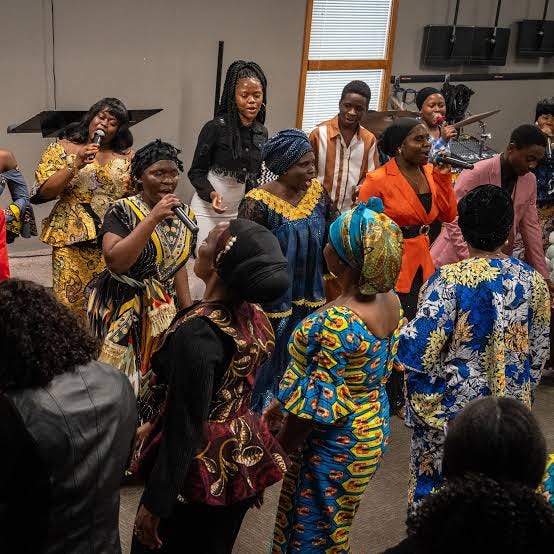
I’m still ruminating over that movie about the young Sudanese men and women who escaped the brutality and killing of a civil war even a few days later.
Coming to the states from Sudan via the Kakuma refugee camp in northern Kenya is a long journey, not just in distance but in culture.
Once when I was home from my overseas work assignment, I was driving through my home town and saw an International Rescue Committee (IRC) office, so surprised, I decided to stop and find out what was happening.
The local director was happy to make time for me and invited me to attend a local volunteer training event at a local church that evening, so I decided to attend. She walked me out to my Dodge diesel pickup and she seemed a little shocked that an aid worker would drive such a thing, until I told her I was honoring and upholding the traditions of my people. She was okay with that.
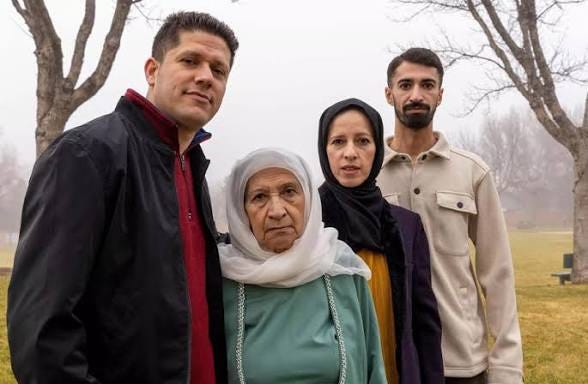
At the training that night, they were planning on receiving a group of Somali Bantus who had spent a generation living at the vast Kakuma refugee camp in northern Kenya, where they lived in tents, carried water, received food rations that were pretty bland and unlike anything they could find here.
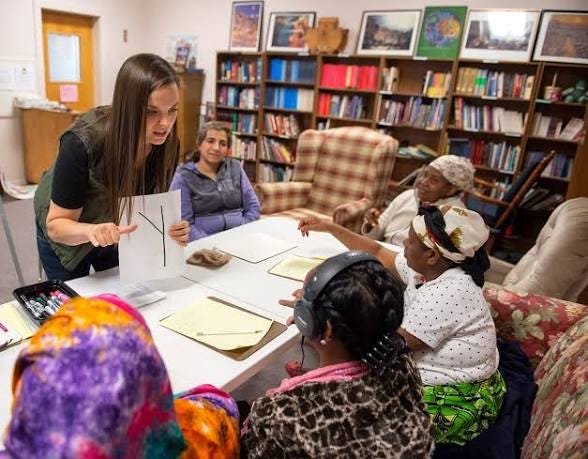
As I listened to the trainer, I was struck by the vast cultural differences between those decent, generous, kindhearted American volunteers and the incoming refugees. They talked about an orientation in the church fellowship hall where the refugees learned the basics of indoor plumbing, microwave ovens, refrigerators, grocery stores, bus services, etc & etc.
I thought about how it might be more comfortable for those pastoralists farmers to spend their orientation near a maize field, or a river where they could catch carp, instead of in a basement on folding chairs without any common cultural markers.
I’ve noticed over the years how in my home town, the refugees tend to fall through the cracks after their initial handholding is pulled back. I see them waiting for buses, sometimes as a group of a dozen or so women sitting on a curb at a bus stop in rain, snow, or shine. They usually dress in traditional cotton cloth chitinges, sometimes a donated jacket, and plastic Bata shoes. I always want to stop, talk to them, hug them, and ask them how I can help.
The best thing I see the community doing for them is to allow them to use vacant land for community gardens. Many churches and the historic synagogue here also have community gardens. They earn cash from the sale of their produce and people support them enthusiastically.
I’ve also noticed young Sudanese men, probably some of the Lost Boys, working on farms. I’ve watched them set irrigation siphon tubes, work in dairies, and do other farm labor. It seems more culturally relevant, given their pastoralist background, and it gives them a good landing place from where they can launch their educational careers.
I worry about these refugees becoming another misunderstood, permanent underclasses, even the kids, because they don’t really blend in with American culture quickly. The United States has changed so much in the past century from an agricultural society to a high tech economy and it’s difficult for someone coming from a traditional rural culture to catch up and find a place. It’s a hard gap to bridge. Maybe it will be easier for the kids.
On one of my trips home from overseas, I decided to talk to a local organization my aunt worked for who started out doing Headstart programs and continued to branch out into other unrelated activities (we always called it being donor driven) because that’s where the money was.
My aunt helped me book an interview with their HR, but the CEO saw my resume and chose to do the interview. I asked a lot of questions about strategic plans, core competencies, funding sources and their constituency. I got a lot of fumbled responses and decided I really didn’t want to work for an organization that was a wind-vane who followed every new donor trend. Been there, did that. Resettling refugees requires experience, sensitivity, and deep cultural understanding
This winter I saw a lot of refugees enduring the cold while waiting for public transportation. I winced, and then wonder what I can do. What can I do?
Some groups do find their way. I’ve interacted with Ukrainians who were electricians, truck drivers, mechanics, and other skilled trades and I am hopeful. There are also many Bosnians who prosper, but I also see Congolese who seem completely lost. And there are a number of refugees who were professionals back home but struggle with licensure here. I have a friend who works at a big grocery store who was an engineer in Iraq, but who works as a cashier because his qualifications aren’t recognized here.
I have Bosnian friend who was brutalized while in Serbian detention. They crushed his right hand, bound it in tape, and let it heal into a misshapen claw. He was an electrical engineer in Bosnia and I met him at a used electronics store. His life has been one long struggle, but he is a good friend who appreciates that I understand the circumstances he came from.
Sometimes, my interactions with refugees results in pure happiness. I was in Harbor Freight once and saw a guy in a white wifebeater t-shirt and blue track pants with a white stripe down the side, a dead giveaway that he was from Eastern Europe and probably from the Balkans. I overheard his accent during a phone call and decided he was Bosnian. After the call, I asked him what part of Bosnia was he from. “A place called Banja Luka,” he said, “do you know it?”
I said of course I did. I was there many times. He asked if I ever went to the restaurant in the cave. I told him it was my favorite restaurant in Banja Luka. He grinned and said he started it!
And there’s a South African who lives here in my little town and who, unsurprisingly, is a friend. Under the old South African apartheid regime, he would have been racially classified as a Cape Coloured, a mixed race Africaans/Malay/ or maybe Black African who often worked in the Cape vineyards and were partly paid in grog to keep them perpetually docile.
In America, he can easily pass as Spanish or Italian, except for his Afrikaans accent. I can’t imagine how wonderful it must feel to been free from old, government sanctioned racial stereotypes.
To all these people I know and love, and who have a piece of my heart, I wish you the best. I know it’s a difficult journey, and I hope you find peace, happiness, and prosperity in your new adopted homeland.
You are such an asset here on Substack but also here in the US of A where assimilation is a challenge faced by so many people fleeing horrendous situations. I've read many of your posts, but I believe this one resonates with me more than any others. It takes me back to my experiences in Ethiopia, the DR, Honduras and all the people I'd love to see settling into some secure and welcome place. Thanks Switter.
You are a special human being who actually invests your time in solutions that scratch that deep itch of compassion. Most people would rather just complain on social media, or shame and blame others.
Good on you. One thing your experience points out that is often missed in this discussion about refugees is that there are worthy people from many nations who need a second chance that only America can give, and that we need to be careful to separate them from the nefarious actors and criminals who would take advantage of us.